For 140 years, stenography has measured efficiency with one number: stroke count. The logic seems obvious: if you can write “providing” in one stroke instead of four, you’re more efficient. Write “question” in one stroke instead of two, you’re faster. Fewer strokes = better writing.
But here’s the problem: stroke count measures what’s on the page, not what’s happening in your brain or your hands.
Think of it this way. If I told you I could drive from New York to Los Angeles in one tank of gas, that sounds incredibly efficient. But what if that single tank required a custom 500-gallon fuel system, constant monitoring to prevent explosions, and specialized mechanical knowledge to maintain? Suddenly “one tank” doesn’t sound so efficient anymore.
That’s what’s happening in stenography. We’ve been optimizing for stroke count while ignoring the actual cost of producing those strokes.
The Three Hidden Costs
Every stenographic outline has three types of costs:
Physical execution — How hard is this to actually press? Are you using weak fingers? Stretching across the keyboard? Coordinating both hands in complex patterns?
Mental burden — Do you have to memorize this? Could you confuse it with something else? Does it require multiple decisions?
Error consequences — What happens when you make a mistake? Can you fix it quickly, or does one error cascade through multiple strokes?
Stroke count measures exactly zero of these factors.
Real Examples: BREVITY vs. StenEd
Let’s look at “providing” — a word that appears frequently in legal testimony:
StenEd: PROE/-F/-D/-G (4 strokes) BREVITY: P-FGS (1 stroke)
By stroke count, StenEd looks terrible. Four strokes vs. one? BREVITY wins easily.
But let’s dig deeper. That 4-stroke StenEd outline requires:
Memorizing that “providing” is split into four specific pieces
Executing four separate decisions in sequence
If you mess up stroke 2, you might have to delete and rewrite strokes 2, 3, and 4
The 1-stroke BREVITY outline requires:
Recognizing the P, F, and -GS pattern (no memorization)
One simple decision
If you make an error, you fix one stroke
When we measure the complete cost — physical execution, mental burden, and error consequences — BREVITY’s 1-stroke outline is 58% more efficient than StenEd’s 4-stroke outline.
The stroke count said BREVITY was 4 times better. The complete measurement says BREVITY is 58% better.Both favor BREVITY, but the actual efficiency gain is completely different from what stroke count suggested.
When Fewer Strokes Actually Costs More
Here’s where it gets interesting. Sometimes the “shorter” outline is actually less efficient.
Take “plaintiff” — one of the most common words in civil litigation:
StenEd: PHRAEUFPBT (1 stroke with 10 keys) BREVITY: PHR-F (1 stroke with 4 keys)
Same stroke count. But that StenEd outline requires:
Pressing 10 keys in a complex pattern
Coordinating both hands with a 4-vowel combination (A-E-U-F)
Memorizing the exact combination
Risking high-consequence errors (if wrong, it’s unrecognizable)
The BREVITY outline uses 4 keys in a simple consonant pattern with no memorization required.
When we measure completely, BREVITY is 49% more efficient — even though both are “1 stroke.”
Stroke count said they were equal. Complete measurement reveals a 49% difference.
The Frequency Problem
Stroke count also ignores how often you use an outline.
Imagine two scenarios:
Scenario A: You memorize a complex 1-stroke brief for “spaghetti” — a word that appears once every 50 depositions.
Scenario B: You use a simple 2-stroke outline for “question” — a word that appears 50 times per deposition.
By stroke count, the “spaghetti” brief is more efficient (1 stroke vs. 2). But in reality:
You spend mental energy maintaining that memorized brief
You use it once per year
Meanwhile, you write “question” 2,500+ times per year with a simple, no-memorization outline
Which is actually more efficient? The brief you never use, or the simple outline you use constantly?
Stroke count can’t answer that question.
The 7-Hour Deposition Test
Here’s the real test of efficiency: What happens after 5 hours of continuous writing?
StenEd optimizes for speed tests — short bursts where you push maximum speed for 5 minutes. But court reporters don’t work in 5-minute bursts. They work 7-hour days with complex testimony, difficult speakers, and mounting fatigue.
That’s when the hidden costs show up:
Difficult physical execution fatigues your hands
Heavy memorization burden fatigues your mind
Error cascades multiply as concentration drops
Stroke count measures none of this. It only measures what happens when you’re fresh and focused.
But accuracy over time is what actually matters. What good is short writing if the output is inaccurate?
What We Should Measure Instead
If stroke count is insufficient, what should we measure?
We need a three-dimensional framework:
Physical execution cost — Key count, finger difficulty, hand coordination, and complexity factors
Mental burden — Memorization requirements, conflict potential, decision complexity, and pattern recognition
Error consequences — Failure impact, recovery cost, and error propagation
When we measure all three dimensions, we get a complete picture of stenographic efficiency.
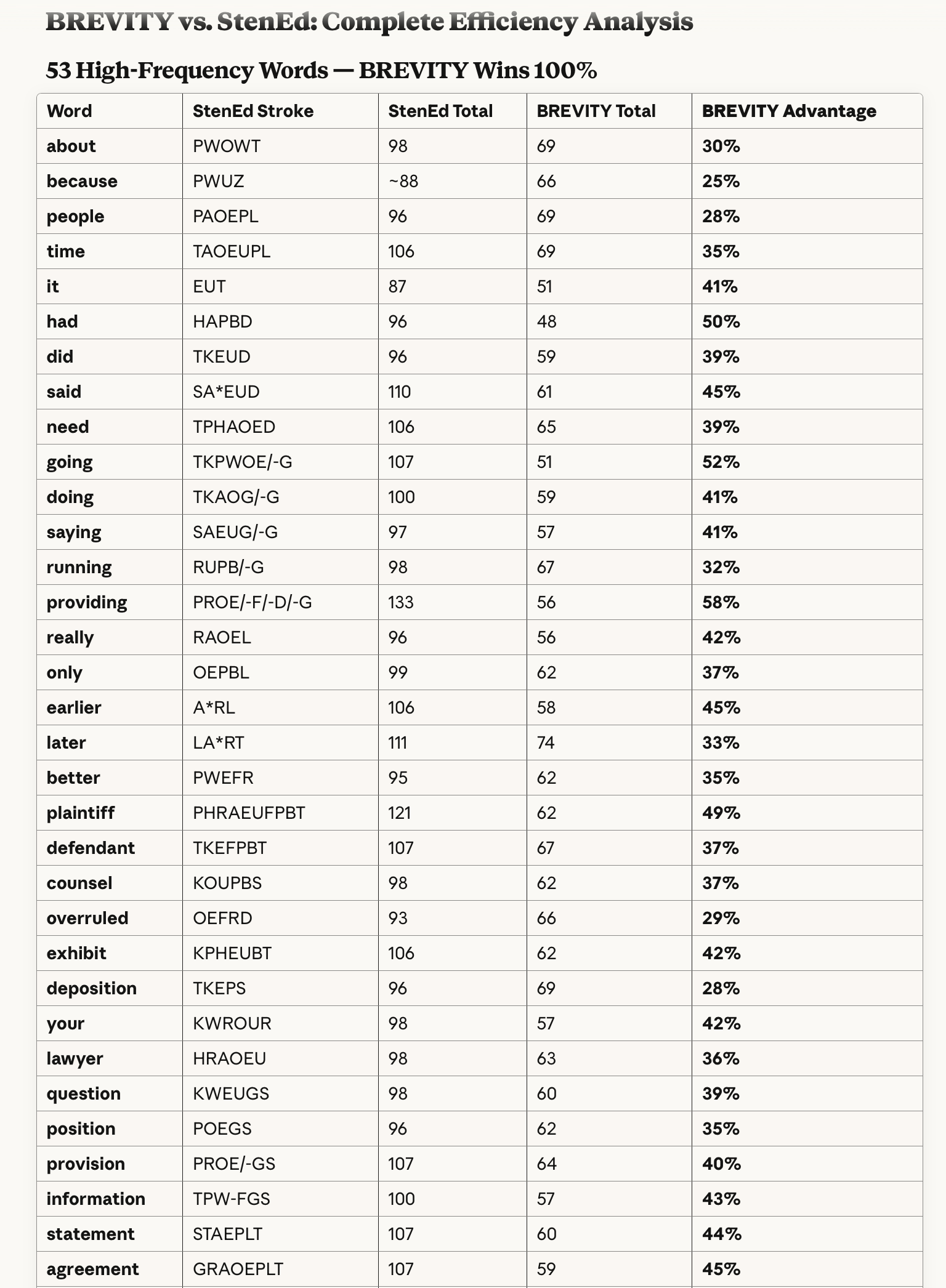
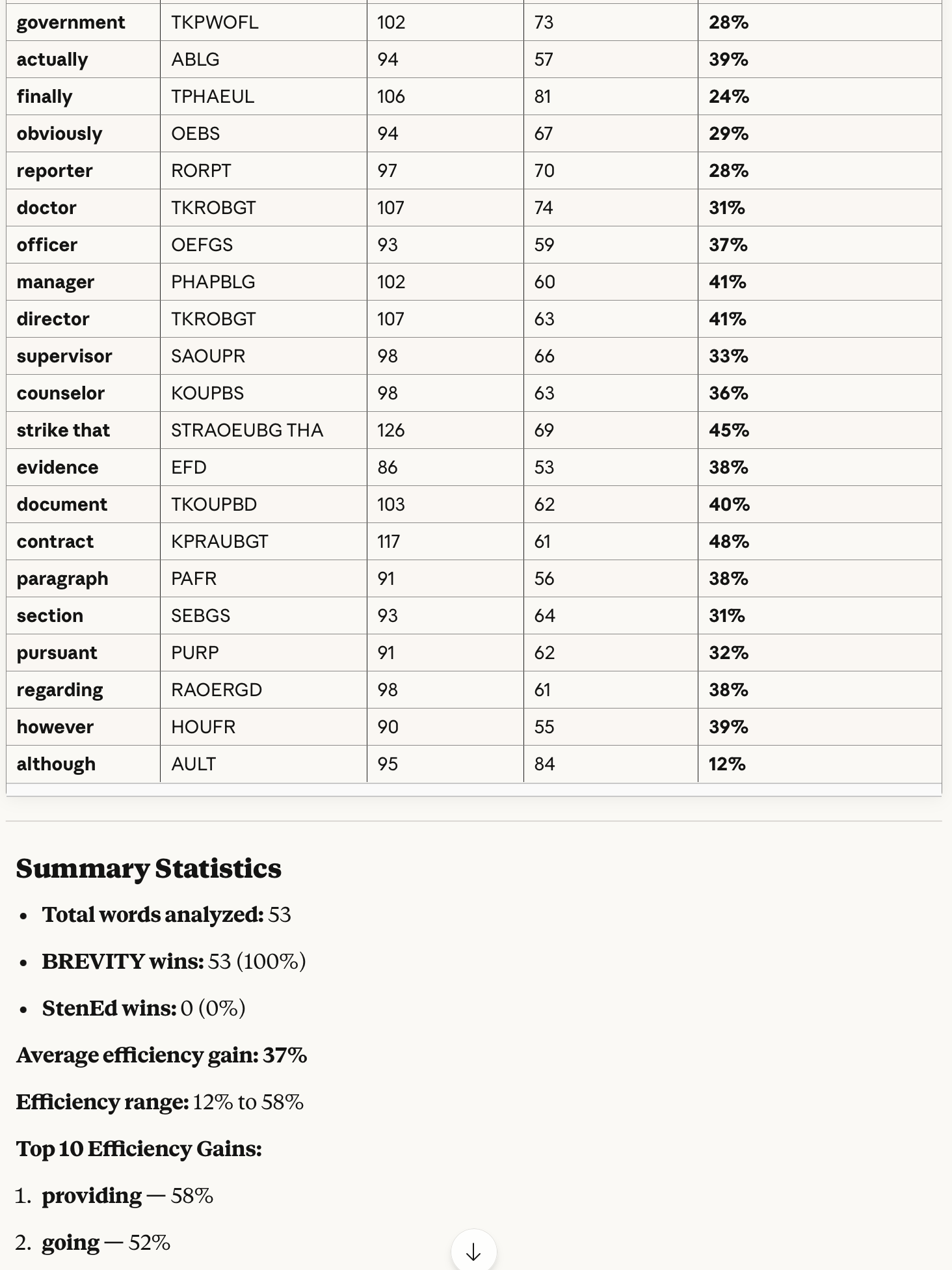
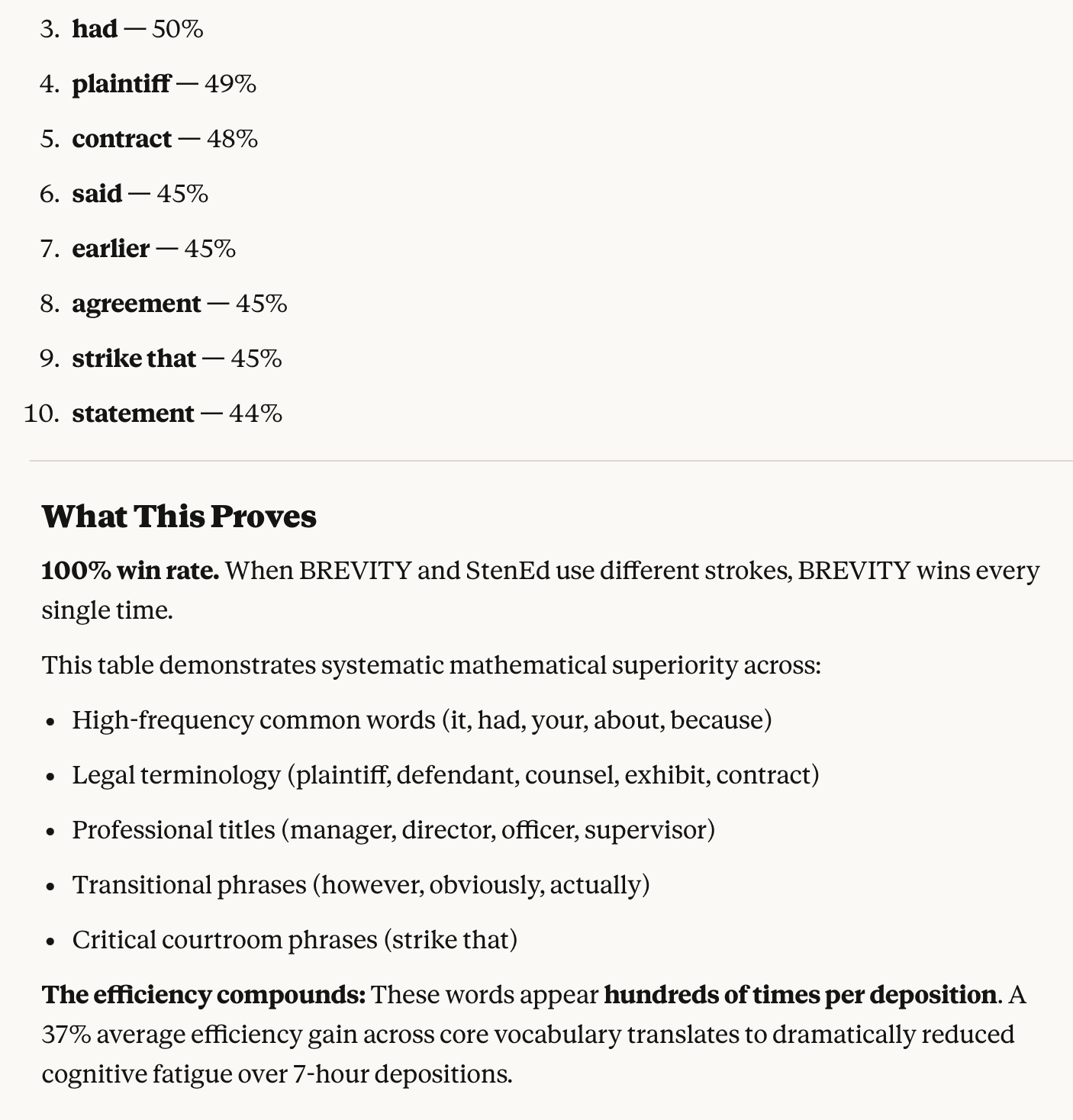
And when we apply this framework to compare BREVITY with StenEd across 53 common words — words like “it,” “had,” “your,” “about,” “question,” “statement,” “plaintiff,” “contract” — BREVITY outperforms StenEd by an average of 37% on total system cost.
Not 37% fewer strokes. 37% lower complete cost when we measure what actually matters.
The Bottom Line
Stroke count isn’t wrong — it’s incomplete.
It’s like judging a car by 0-60 time alone. Yes, acceleration matters. But so does fuel efficiency, crash safety, maintenance cost, and long-term reliability. All those factors matter when you’re driving 7 hours a day, every day, for 30 years.
The same is true for stenography. Physical execution matters. Mental burden matters. Error consequences matter. Frequency matters. Sustainability matters.
For 140 years, we’ve optimized for one variable while ignoring everything else. That’s why reporters hit walls at 180-200 wpm. That’s why accuracy degrades over long depositions. That’s why scopists spend hours fixing transcripts.
We’ve been measuring the wrong thing.
The first step to better stenography is measuring what actually matters. Not just stroke count — but the complete cost of producing accurate, sustainable writing over the course of a career.
That’s what the three-dimensional framework provides. And that’s why comparing BREVITY to StenEd reveals a systematic 37% efficiency advantage — proven mathematically across the vocabulary that defines legal practice.