
The court reporting profession can dramatically improve its completion rates by replacing slogan-based education with a scientific protocol that evaluates stenographic theories for biological and empirical validity.
This protocol provides a repeatable method for evaluating advice, maxims, and “thought for the week” statements in stenographic education.
It does not attack people. It does not dismiss experience. It does not require you to abandon anything that works for you.
It asks one question: Does this claim survive contact with definitions?
Most don’t.
Why This Matters
Stenographic education runs on slogans.
“Shorter strokes mean less effort.”
“Faster fingers and shorter strokes.”
“Those who won’t spend time shortening their writing spend too much energy.”
“Brief it or be buried by it.”
These statements sound wise. They get repeated. They shape how students think about failure and success.
But slogans are not theories. They compress assumptions into phrases that bypass scrutiny. The compression is the danger—it hides the premises that would collapse if examined.
This protocol examines them.
The Five-Step Method
Step 1: Identify the Hidden Variables
Every slogan contains undefined terms. Find them.
Example: “Those who won’t spend a little time every day shortening their writing spend a lot of time every day expending way too much energy.”
(This happens to be the thought for the week on a popular steno website. Can you guess which one? It has provided me such rich material!)
Hidden variables:
Shortening — Shortening what? Stroke count? Key count? Cognitive load? Physical difficulty?
Energy — Physical energy? Mental energy? Attention? Decision bandwidth?
Time — Practice time? Recovery time? Consolidation time? On-the-job time?
The slogan treats these as self-evident. They are not. Each undefined variable is a claim disguised as a fact.
Action: List every noun and verb that could mean more than one thing. These are your targets. Color them blue.
Step 2: Test the Implied Causality
Slogans assert cause and effect without evidence. Make the causality explicit, then ask whether it holds.
Example claim: Shortening → Less energy
Explicit version: Reducing stroke count causes reduced energy expenditure.
Test questions:
Are all strokes equivalent units of effort?
Does a 9-key single stroke cost less than two 4-key strokes?
Does memorizing the shorter outline add or subtract cognitive load?
Does the shorter outline increase or decrease error probability?
If strokes are not equivalent containers, then “shortening” is not a coherent optimization target. The causality fails.
Action: Rewrite the slogan as an if-then statement. Then ask what evidence would falsify it. Color these red.
Step 3: Check for Moral Framing
Slogans often smuggle blame into description. Identify the moral language.
Example: “Those who won’t spend a little time…”
“Won’t” is not neutral. It implies:
Refusal, not inability
Character flaw, not constraint
Voluntary choice, not systemic overload
Compare: “Those who don’t spend time…” (neutral) vs. “Those who won’t…” (accusatory)
The moral frame shifts responsibility from the system to the student. This is a claim about human psychology, not stenographic mechanics. It requires evidence.
Test questions:
What evidence supports the claim that failure here is volitional?
Could the same outcome result from overload rather than refusal?
Does the advice account for biological variation in learning capacity?
Action: Circle every word that assigns praise or blame. Ask whether the assignment is justified or assumed. Color these beet red.
Step 4: Expose the Universality Assumption
Slogans present themselves as laws. They rarely are.
Example: “Every day” implies:
All brains benefit from daily intervention
No recovery cost exists
No consolidation window matters
Fatigue is linear, not compounding
Biological reality:
Learning requires spacing, not constant repetition
Motor trust degrades under continuous self-monitoring
Cognitive debt compounds nonlinearly
Individual variation in processing speed is substantial
A claim that ignores biological constraints is not advice. It is ideology.
Test questions:
Under what conditions would this advice fail?
For whom would the opposite advice be correct?
What would falsify the universal claim?
Action: Add “for everyone, always” to the end of the slogan. If it sounds absurd, the universality was never justified. Color these Bozo orange.
Step 5: Compare with Outcomes
The final test: Does the advice predict results?
If “shortening every day” produces better outcomes, we should see:
Higher completion rates among aggressive brief users
Lower burnout in memorization-heavy systems
Fewer drops as dictionary size increases
Faster skill acquisition with more briefs
The data show the opposite:
90%+ of students never reach professional speed
Burnout correlates with cognitive load, not stroke count
Instability increases with outline complexity
The profession has a retention crisis despite decades of “shorten everything” advice
When advice and outcomes diverge, the advice is wrong.
Action: Name three measurable predictions the slogan makes. Check whether reality confirms them. Color these your favorite color, but, remember, no conflicts!
Most say conflicts are bad and we shouldn’t have any, even smart ones.
Conflict-free theories are partly to blame for the explosion in theory complexity.
Here’s a better solution:
Think of every possible conflict no matter how unlikely that conflict is to occur, then make a list. Delete the list because there’s likely an obscure conflict you haven’t thought of.
If you can’t think of everything, don’t bother.
Forget about your favorite color.
Color this black.
Worked Example
Slogan: “Those who won’t spend a little time every day shortening their writing spend a lot of time every day expending way too much energy.”
Step 1: Hidden Variables
Shortening = undefined (stroke count? key count? load?)
Energy = undefined (physical? cognitive? attentional?)
Time = undefined (practice? recovery? on-the-job?)
Step 2: Implied Causality
Claim: Shortening → Less energy
Test: Are strokes equivalent units? No. A 9-key stroke costs more than two 4-key strokes.
Result: Causality fails.
Step 3: Moral Framing
“Won’t” implies refusal, not inability
No evidence provided that failure is volitional
Result: Blame assumed, not demonstrated.
Step 4: Universality
“Every day” ignores spacing, consolidation, recovery
“Those who…” applies to all learners regardless of variation
Result: Universal claim unsupported by biology.
Step 5: Outcomes
Prediction: More shortening → better results
Reality: 90% dropout rate despite industry-wide commitment to shortening
Result: Prediction falsified.
Conclusion: The slogan contains at least five unsupported assumptions, relies on undefined variables, smuggles blame into description, and makes predictions that outcomes contradict.
It is not advice. It is a belief system compressed into a sentence.
The Asymmetry
This protocol does not require you to be hostile. It does not require counter-slogans. It does not require charisma or authority.
It requires definitions.
Slogan-based systems cannot provide them. They rely on:
Intuition
Repetition
Authority
Social proof
Definition-based analysis relies on:
Units
Models
Biology
Outcomes
That asymmetry is permanent. Every new slogan becomes raw material for the same process.
You are not refuting a theory. You are showing that no theory was ever formalized.
The Deeper Point
This protocol exists because stenographic education never developed one.
The profession transmits advice through repetition rather than verification. Slogans replaced science. Testimonials replaced measurement. Authority replaced evidence.
The result: a 90% failure rate blamed on students rather than systems. Higher, in many cases.
The protocol does not fix that history. But it provides a tool for anyone who wants to stop perpetuating it.
Define your terms. Test your causality. Check your blame. Question your universals. Compare with outcomes.
That’s it. Five steps. No hostility required.
The slogans that survive this process might actually be true.
The ones that don’t were never more than comfortable myths.
Appendix: Common Slogans and Their Failure Points
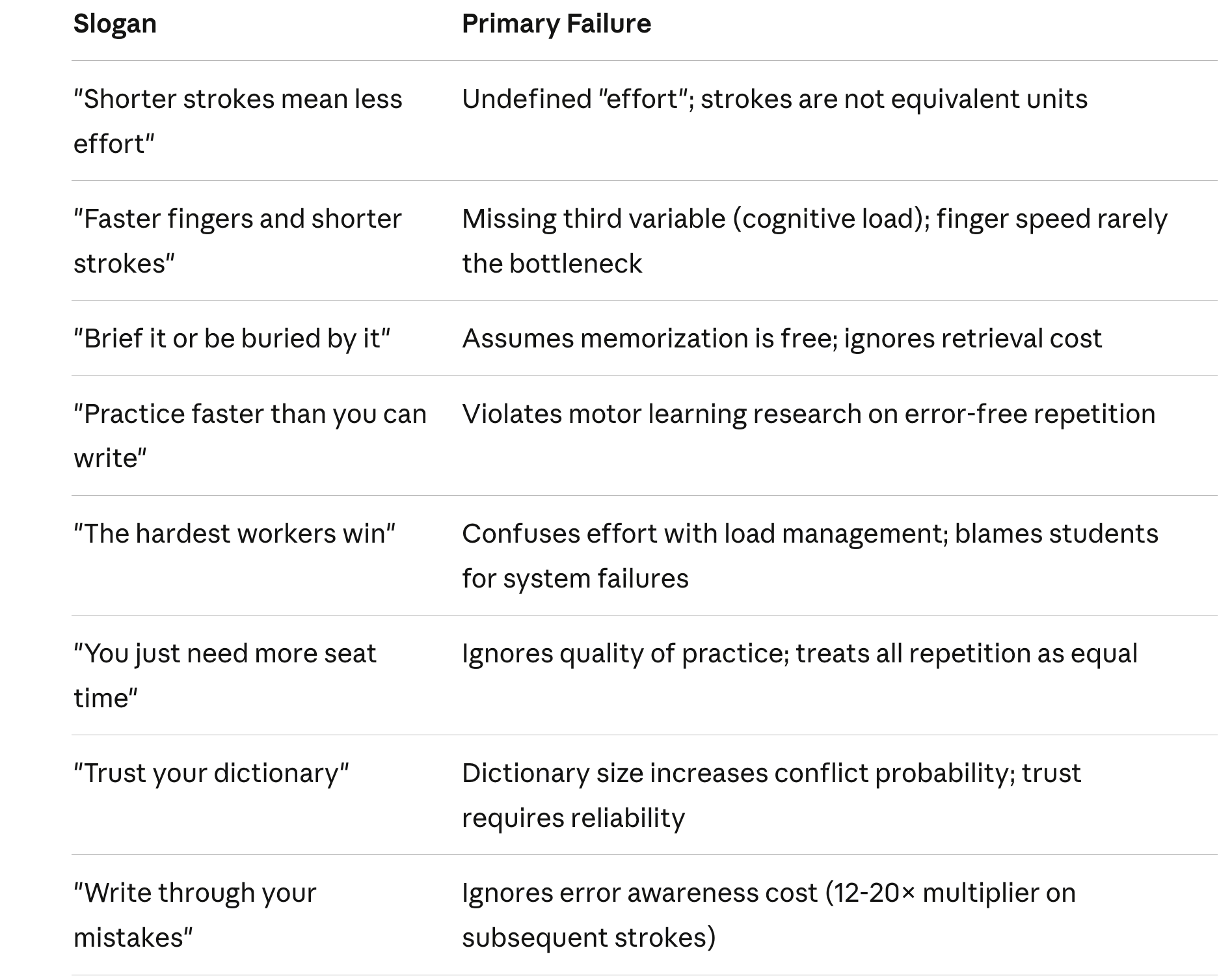
Each slogan compresses assumptions that collapse under examination.
The protocol makes the collapse visible.
This document may be freely shared, adapted, and used for educational purposes.